


A short guide to our approach
It is important to understand the macro environment we are in. It is similar to having a weather forecast, which helps make more informed decisions, adapt to the situation, and avoid hazards.
When it comes to investing and speculating, there is no certainty, only probabilities. We have an open-minded approach.
We make the distinction between investing (owning something that pays you) and speculation. (buying an asset with the presumption that the price will appreciate over time)
Each action should have a different strategy.
-
For investing: Assessing the opportunity cost of holding the yielding asset in the current macro environment.
-
For speculating/momentum strategies: Looking for good risk-reward trades. Defined risk in each trade, based on risk tolerance and estimated asset volatility.
Every good investment is also a good speculation.
The distinction is in the fact that you are paid to wait for the thesis to play out.
Our investment philosophy was shaped by our mentors, market history, experience, and tape watching. (the price action given the news flow)
When we talk about diversification, we mean geographical, sectoral, and asset-type diversification, etc.
We are using long-only strategies, giving the risk-reward, and do not want to fight the secular trend in equities. (the upper drift)
Our main analysis is fundamental, but we use technical analysis to track flows, find good entry/exit levels, and observe market behavior.
When we refer to being contrarian, that is reflected in terms of positioning, not fighting trends. Here we find good risk-reward trades in unloved sectors essential to the global economy.
Our edge comes from being analytical, disciplined in following the process, and always trying to improve.
Some patterns that we recognized:
-
The market tends to overreact to the news, having a manic-depressive reaction. We do not use leverage to avoid being shaken out of a position by the volatility these events create. This volatility unintuitively provides us with good opportunities to enter/exit positions.
-
Many companies under our radar have been acquired and taken private. The value that we see in some stocks is recognized by private equity firms, other smart money institutions, and investors.
-
When everybody is in consensus, something different almost always happens. That is why we like to buy panic and sell exuberance.
One of the sentences that reflects our investment philosophy and process was said by Howard Marks:
“There are no bad assets, only bad prices.”
Disclaimer: This newsletter is for educational and informational purposes only and does not constitute investment advice. The author may hold positions in the assets discussed.
By reading this, you agree to our Full Legal Disclaimer.

Market lessons from the recent price action in the energy sector
We can not predict the future. That is why proper diversification across unrelated assets is the best proposition in investing.
A good lesson is the current price action in the oil and energy sector.
This is how we were positioned for these circumstances:
Given this historically disruptive situation in the Strait of Hormuz, we took an early overweight position in energy equities. From a risk-reward perspective, it seemed the most obvious at the time, given the instruments available to us to trade in the sector. We understood the potential disruption to the global energy market. So we sold some positions that usually do not work in a risk-off scenario or are disrupted by the oil shock.
We observed how our position responded to news flow and developing events.
The headline volatility during the conflict provided a good rehearsal on how our positions respond to both escalatory and peace-attempting events.
Our energy equities did not appreciate much in price, given the circumstances.
The AI theme on the other side was on fire.
We started looking for reasons to exit because the price action did not confirm our thesis.
After the conflict reignited over the weekend before June 8th, some of the equities we are tracking from the energy stocks basket failed to rally.
Based on this news failure event and other information we observed in the conflict’s dynamics, we sold most of our speculative energy holdings, except for some higher-quality holdings that we believe are undervalued. These are a good investment because they pay good dividends and help diversify the portfolio.
During this sell-off, we once again realize the importance of having a defined stop-loss when speculating on an asset’s price direction.
We were overweight, but the stop loss saved us in time from the blood bath that followed.
Paraphrasing Jason Shapiro from The Crowded Market Report, you are incurring big losses because you are not disciplined enough to take small losses.
Usually, when your view is correct, the market price action confirms it.
We learned our lesson.
In the current market conditions, we will take a more active role, putting on the trader’s hat and applying principles that have proven effective in trading.
We recommend this Substack article by Ray Dalio that explains his philosophy of “Diversify Well”.
Disclaimer: This newsletter is for educational and informational purposes only and does not constitute investment advice. The author may hold positions in the assets discussed. By reading this, you agree to our Full Legal Disclaimer.

This article summarizes the background and the investment performance of our Chief Investment Strategist.
I graduated from the Electronics, Telecommunication, and Information Technology University in Romania in 2014, but my path took a different turn.
I played poker professionally for more than 10 years.
At some point, I became concerned about inflation and started looking for ways to invest.
I discovered that if you want to succeed in both poker and investing, there are similar principles that you should follow:
-
Understand the fundamentals.
-
Have the discipline to control your emotions and follow the right process.
-
Have a strong risk management to survive variance.
-
Have resilience and keep playing/trading according to your process.
The 2020 V-shaped recovery inspired me about the good opportunities that sometimes arise.
I have read Benjamin Graham’s The Intelligent Investor and Security Analysis, and I started my investment journey as a value investor in March 2021.
After I studied other mentors, market price action, investors/traders, and institutions’ behavior, I discovered that this framework was too rigid for the current environment.
I adapted by incorporating additional technical signals and fundamental statistics into my process.
The strategy resonates more with investing than trading.
With a time frame of 6 months to 1 year, sometimes even less if it works in our favor.
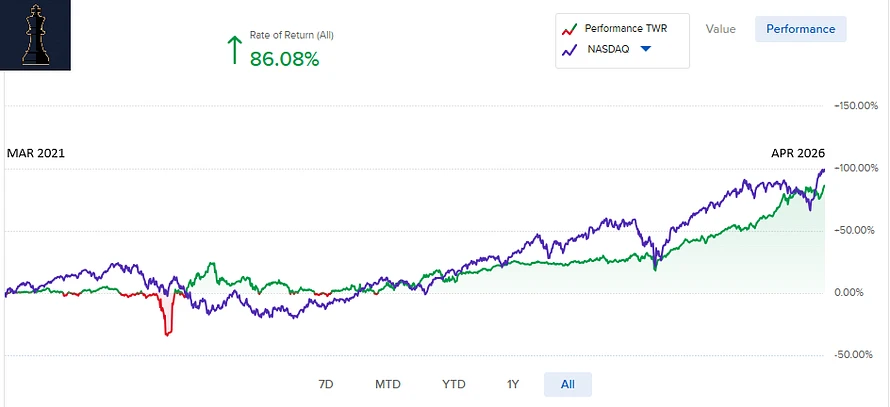
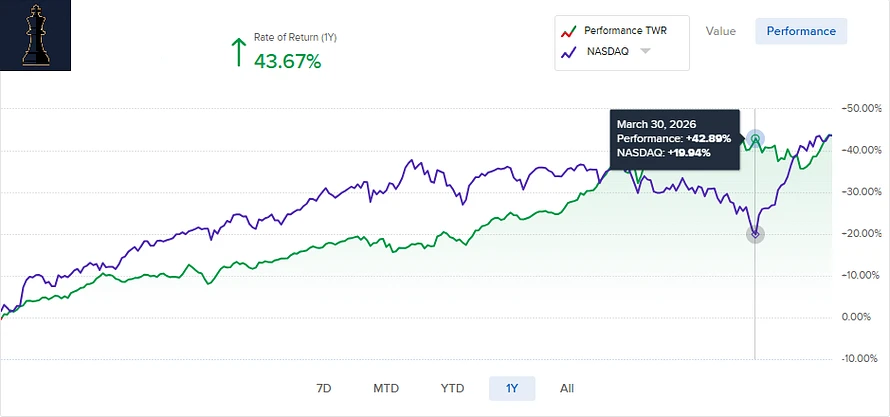
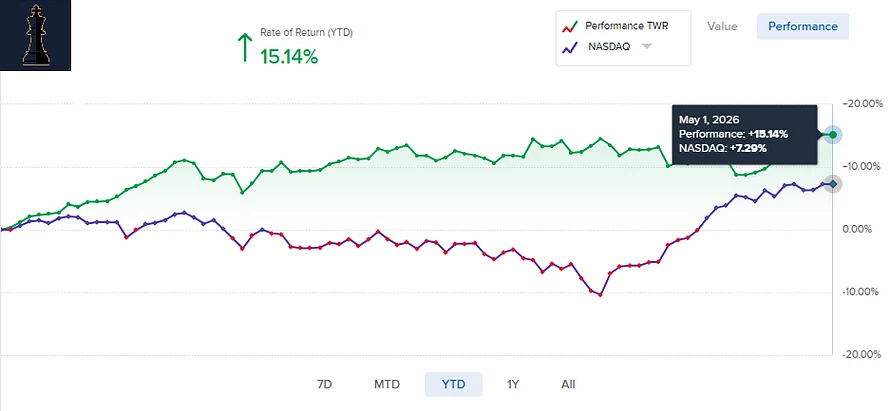
It follows a lower-volatility approach in the long term, outperforming without taking on extra risk.
This graph shows my investment performance vs. the Nasdaq index from March 2021, when I started investing:
The following graph shows my investment performance vs. the Nasdaq index for 1 year:
This graph shows my investment performance vs. the Nasdaq index for this year:
Disclaimer: This newsletter is for educational and informational purposes only and does not constitute investment advice. The author may hold positions in the assets discussed. By reading this, you agree to our Full Legal Disclaimer.